 Rachel Sanders
Bloat kills fast. Not “maybe serious if untreated” fast. More like “your dog was fine at dinner and gone by midnight” fast. I’ve seen it happen, and I’d rather walk you through this in graphic detail right now than have you Google symptoms at 11 PM while your dog is in the car.
The medical term is GDV: gastric dilatation-volvulus. The stomach fills with gas, then twists on itself, cutting off blood supply to the stomach wall and, through pressure on major vessels, to the rest of the body. The dilation alone can kill. The volvulus makes it a near-certain death sentence without surgery. You cannot fix this at home, you cannot wait until morning, and no amount of Gas-X is going to help once the stomach has rotated.
That’s the thing most articles bury in paragraph six. I’m putting it here.
What Bloat Actually Looks Like (And What People Miss)
The classic image is a dog with a visibly distended, drum-tight belly. That’s real, and when you see it, you already know something is very wrong. But bloat often presents before that point, and that’s where owners lose time.
The first sign is usually restlessness. Not “needs a walk” restless. Pacing, can’t settle, keeps standing up and lying down. Dogs in early GDV look uncomfortable in a way that’s hard to explain but easy to recognize once you’ve seen it. They may keep looking at their abdomen, the same way a dog with a stomachache circles before lying down, except they can’t find a comfortable position no matter what.
Unproductive retching is the other big one. They’re heaving, sometimes repeatedly, but nothing’s coming up, or maybe a small amount of white foam. This is the sign most people describe when they call an emergency clinic. “He keeps trying to throw up but nothing’s happening.” That’s a red flag. A big one.
Other signs, roughly in order of how reliably they appear:
- Bloated, tight abdomen (tap it with your fingers, it sounds hollow, like a melon)
- Hypersalivation, drooling more than normal
- Obvious distress, whining, or appearing painful when you touch the belly
- Pale or white gums (this is late-stage, things are already critical)
- Weakness, collapse, rapid shallow breathing
Pale gums mean shock is setting in. If you’re checking gums and they’re white or gray instead of pink, you’re past “should we go?” territory. Go.
One thing that trips people up: early bloat can look like a dog that ate too much and is uncomfortable. The difference is trajectory. A dog who ate too much will usually settle down within 30-45 minutes. A dog with GDV gets progressively worse, not better.
The Breeds and Risk Factors That Matter
Deep-chested, large breeds are the textbook cases. Great Danes have a lifetime bloat risk somewhere around 37%, which sounds unreal until you’ve worked in a practice that sees them regularly. Other high-risk breeds include Standard Poodles, German Shepherds, Weimaraners, Saint Bernards, Gordon Setters, and Irish Wolfhounds. Dobermans. Boxers less so, but still worth knowing.
That said, I’ve seen bloat in a Dachshund. Size isn’t a guarantee of safety.
Risk factors beyond breed: eating one large meal a day (versus two or three smaller ones), eating very fast, exercising vigorously right after eating, stress, and a first-degree relative who’s had GDV. A dog who’s already had a GDV, even one that was treated surgically with a prophylactic gastropexy (where they tack the stomach down to prevent future rotation), is at reduced risk of the twist, but can still experience dilation.
Age matters too. Middle-aged to older large-breed dogs are at higher risk. That doesn’t mean a two-year-old Great Dane can’t bloat. They can.
If you have a high-risk breed, ask your vet specifically about preventive gastropexy, ideally at the time of spay or neuter. It doesn’t prevent all bloat, but it prevents the fatal twist. The AAHA hospital accreditation standards include GDV as a condition where informed owner education is expected. A good practice will bring this up with you. If they haven’t, ask.
When to Go Right Now vs. When You Have Five Minutes
Understanding Bloat in Dogs: Causes, Warning Signs & How to Prevent It! · American Standard Dog Training on YouTube
Honest answer: if you genuinely suspect bloat, you should be in the car before you finish reading this section. GDV moves fast enough that “I’ll watch him for another hour” has cost dogs their lives.
But I also know people panic and every stomachache becomes a potential emergency. So here’s how I think about it.
Go immediately, no watching and waiting:
Your dog is retching repeatedly without producing anything. Your dog has a visibly distended belly and is restless or in obvious distress. Your dog has pale, white, or bluish gums. Your dog has collapsed or is having trouble standing. Your dog is a known high-risk breed and is showing any combination of discomfort plus belly changes.
You might have a few minutes to assess, but don’t wait long:
Your dog ate a large meal and seems uncomfortable, is mildly restless, but isn’t retching. Gums are pink, the belly isn’t obviously tight. In this case, watch closely for 20 minutes, max. If things are improving, you’re probably okay. If things are staying the same or getting worse, go.
There’s no home test for GDV. You cannot tell from outside whether the stomach has twisted. X-rays confirm the diagnosis, and surgery is the only treatment once volvulus has occurred. The window between onset and death without treatment can be as short as a few hours.
Call ahead to the emergency clinic while someone else drives. They can prep for a potential GDV patient and have things ready when you arrive. Don’t waste time in the parking lot filling out forms.
What Happens at the Vet
They’ll do a physical exam first, check gum color, capillary refill time, heart rate. If GDV is suspected, they’ll take radiographs. The classic x-ray image is called a “double bubble” or “Popeye arm” shape, where the rotated stomach shows a distinct compartmentalized gas pattern. It’s pretty unmistakable once you’ve seen a few.
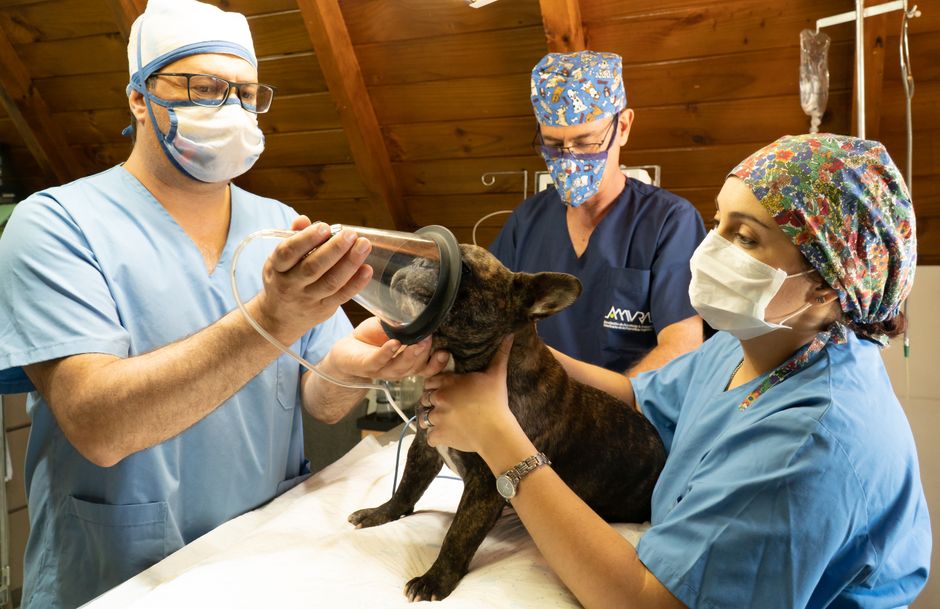
If the x-ray confirms GDV, surgery is the only option. Before surgery, they’ll work to stabilize your dog: IV fluids to treat shock, pain management, sometimes attempting to decompress the stomach with a tube or needle. Stabilization can take 30-60 minutes before the dog is stable enough to anesthetize safely.
The surgery itself involves derotating the stomach, assessing the stomach wall and spleen for tissue death (necrotic tissue has to be removed), and performing a gastropexy to prevent future rotation. Cases where significant tissue has already died carry a much worse prognosis. This is why time matters so much.
Survival rates for GDV surgery at well-equipped facilities run roughly 80-85% when the dog is in reasonably stable condition on presentation. That number drops substantially with delayed treatment or when parts of the stomach wall are already dead. A dog that arrives in shock with necrotic tissue is a very different case than one who arrives within two hours of symptom onset.
Cost is real and I won’t pretend otherwise. GDV surgery at an emergency facility can run anywhere from $3,000 to $8,000 or more depending on location, complexity, and whether complications arise. Pet insurance that covers emergencies is genuinely worth it for large-breed dogs. If you have a Great Dane or a Standard Poodle and you don’t have insurance, think hard about that.
A Note on False Bloat
Not every distended belly is GDV. A dog can have simple gastric dilatation without volvulus, meaning the stomach is very gassy and stretched but hasn’t twisted. This is still uncomfortable and still worth a vet visit, but it’s not immediately life-threatening in the same way.
The problem is that you can’t tell from the outside which one you’re dealing with. That’s the vet’s job. Don’t let the possibility of “it might just be gas” talk you into waiting at home if your dog is showing real distress.
There’s also a condition called splenic torsion that can look similar. Same urgency, same approach: go now.
The ASPCA Poison Control Center gets a lot of calls from panicked owners at midnight, and so do emergency vet clinics. Being that panicked owner is not something to be embarrassed about. What matters is that you went.
Trust your gut about your dog. You know what “normal” looks like for them. If something feels wrong and you can’t shake it, that’s worth a phone call to an emergency line, even just to describe what you’re seeing. A good emergency clinic would rather talk you through it than have you wait too long.
Sources
- AAHA hospital accreditation standards
- ASPCA Poison Control Center
- EVERLIT 95-Piece Vet-Approved Pet First Aid Kit
- Nutramax Cosequin DS Joint Supplement for Dogs (132ct)
- Nans K
Disclosure: As an Amazon Associate, we earn a small commission from qualifying purchases at no extra cost to you. We only recommend products that genuinely support the topics covered in this article.
- EVERLIT 95-Piece Vet-Approved Pet First Aid Kit (~$32), Vet-approved 95-piece kit for dogs and cats, covers cuts, burns, sprains, and emergencies until you can reach a vet.
- Nutramax Cosequin DS Joint Supplement for Dogs (132ct) (~$36), The #1 veterinarian-recommended joint supplement brand, clinically studied for reducing joint pain in dogs.
This article is for general informational purposes only and does not constitute veterinary advice. Pet health symptoms can have many causes and require professional evaluation. Always consult a licensed veterinarian for diagnosis and treatment specific to your pet.
Photo: Nans K via Pexels
Recommended Resources
Disclosure: As an Amazon Associate, we earn a small commission from qualifying purchases at no extra cost to you. We only recommend products that genuinely support the topics covered in this article.
- EVERLIT 95-Piece Vet-Approved Pet First Aid Kit (~$32), Vet-approved 95-piece kit for dogs and cats, covers cuts, burns, sprains, and emergencies until you can reach a vet.
- Nutramax Cosequin DS Joint Supplement for Dogs (132ct) (~$36), The #1 veterinarian-recommended joint supplement brand, clinically studied for reducing joint pain in dogs.